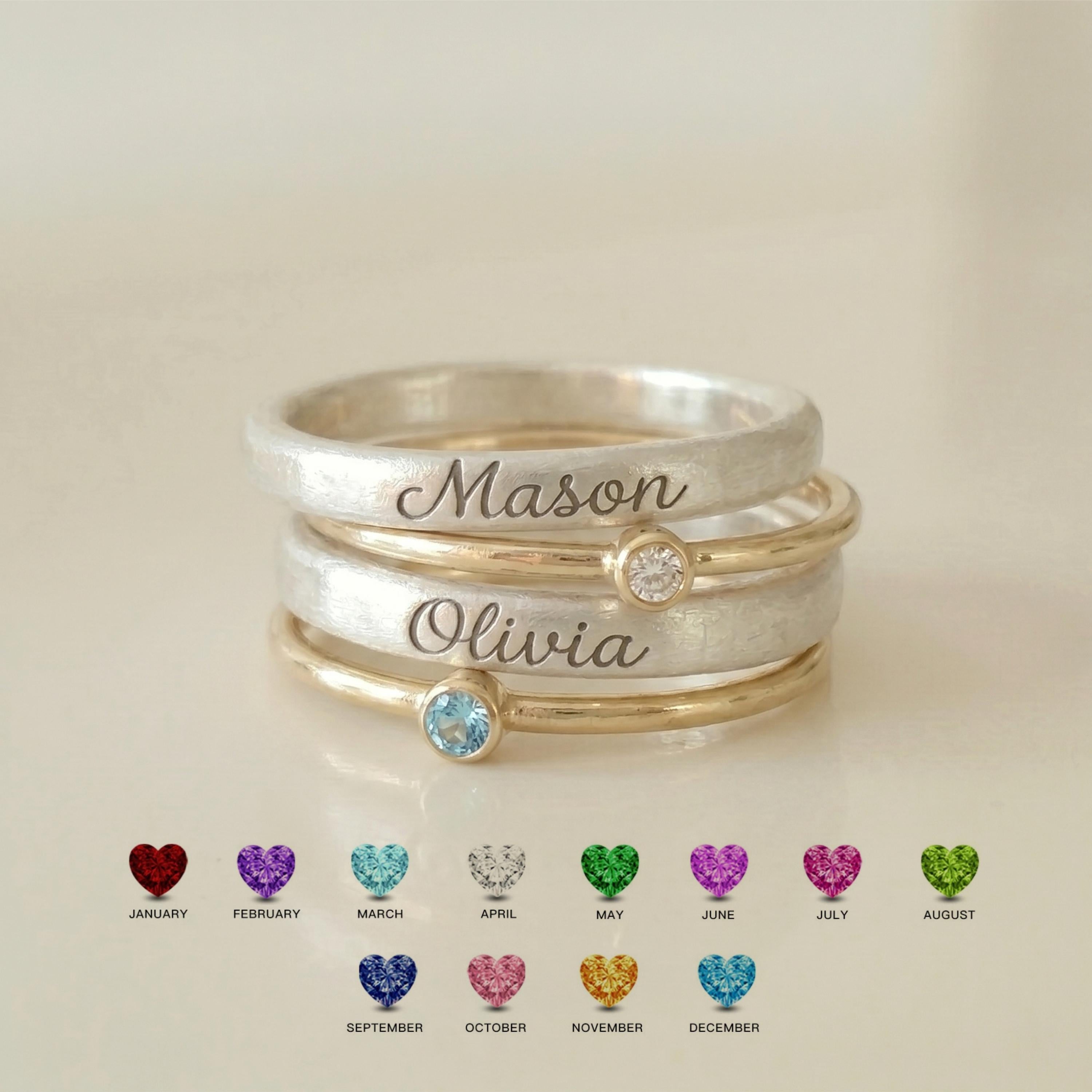
.fbj{–ivory:#fbf7f2;–cream:#f5eee6;–paper:#fffdf9;–ink:#2f2925;–muted:#786d65;–line:#e8ddd2;–gold:#a98559;–blush:#f0e0dc;max-width:1120px;margin:0 auto;background:var(–paper);color:var(–ink);font-family:Georgia,’Times New Roman’,serif}.fbj *{box-sizing:border-box}.fbj .hero{display:grid;grid-template-columns:1.04fr .96fr;background:var(–ivory);border:1px solid var(–line);border-radius:22px;overflow:hidden}.fbj .heroCopy{padding:72px 9%;display:flex;flex-direction:column;justify-content:center}.fbj .hero img{width:100%;height:100%;min-height:520px;object-fit:cover}.fbj .eyebrow{font:700 12px/1.3 Arial,Helvetica,sans-serif;letter-spacing:.18em;text-transform:uppercase;color:var(–gold);margin:0 0 18px}.fbj h1{font-size:clamp(38px,5vw,64px);line-height:1.03;font-weight:400;margin:0 0 24px}.fbj h2{font-size:clamp(30px,3.5vw,47px);line-height:1.08;font-weight:400;margin:0 0 20px}.fbj h3{font-size:22px;line-height:1.22;font-weight:400;margin:0 0 10px}.fbj p{font-size:18px;line-height:1.75;color:#443c37;margin:0 0 18px}.fbj .lead{font-size:21px;line-height:1.65;color:var(–muted)}.fbj .section{padding:72px 7%;border-left:1px solid var(–line);border-right:1px solid var(–line)}.fbj .quote{padding:46px 8%;text-align:center;background:var(–cream);border-left:1px solid var(–line);border-right:1px solid var(–line)}.fbj .quote p{font-size:clamp(25px,3vw,38px);font-style:italic;line-height:1.35;color:var(–ink);margin:0}.fbj .stack{max-width:620px;margin:34px auto;background:var(–ivory);border:1px solid var(–line);border-radius:20px;padding:38px}.fbj .band{display:grid;grid-template-columns:48px 1fr 80px;align-items:center;gap:16px;background:#fff;border:1px solid var(–line);border-radius:999px;padding:12px 18px;margin:12px 0}.fbj .n{width:38px;height:38px;border-radius:50%;background:var(–blush);display:flex;align-items:center;justify-content:center;font:700 12px Arial;color:var(–gold)}.fbj .gem{width:24px;height:24px;border-radius:50%;background:#aab798;justify-self:end}.fbj .cards,.fbj .products,.fbj .related{display:grid;grid-template-columns:repeat(3,1fr);gap:18px;margin-top:30px}.fbj .card{border:1px solid var(–line);border-radius:18px;background:#fff;padding:27px}.fbj .product{border:1px solid var(–line);border-radius:16px;overflow:hidden;background:#fff;text-decoration:none;color:inherit}.fbj .product img{width:100%;aspect-ratio:1/1;object-fit:cover}.fbj .product div{padding:20px}.fbj .note{font:600 14px/1.55 Arial,Helvetica,sans-serif;color:var(–muted)}.fbj .button{display:inline-block;background:#2f2925;color:#fff!important;text-decoration:none;padding:16px 24px;border-radius:999px;font:700 13px/1 Arial,Helvetica,sans-serif;letter-spacing:.08em;text-transform:uppercase}.fbj .related a{display:block;text-decoration:none;color:inherit;border:1px solid var(–line);border-radius:14px;padding:22px;background:#fff}@media(max-width:760px){.fbj .hero{grid-template-columns:1fr}.fbj .heroCopy,.fbj .section{padding:48px 22px}.fbj .hero img{min-height:0;aspect-ratio:1/1}.fbj .stack{padding:22px}.fbj .band{grid-template-columns:42px 1fr 30px}.fbj .cards,.fbj .products,.fbj .related{grid-template-columns:1fr}.fbj p{font-size:17px}}
FarahBlush Journal · Family Stacks
A family story does not always need to be compressed into one ring face. A stack can give each child a separate layer while still reading as one family piece when worn together.
“One child, one layer. One stack, one family.”
Why the Architecture Works
Separate Identity Without Separating the Family
In a single multi-stone ring, several people share one composition. In a stack, each personalized band can hold one name, one stone, or one part of the story. The visual result is layered rather than crowded.
The value is not that a stack is automatically better. It is that each child’s identity can remain visually distinct while the bands still belong to the same set.
A Verified Stacking Example
BRS021: One Name and One Birthstone per Band
BRS021 is the clearest current example of the one-person-per-band idea. Its product description specifies a custom engraved name and one birthstone per band, and states that the rings can be worn together or separately.
That makes it useful when you want each person to have an individual layer rather than assigning several names and stones to one shared ring surface.
Different Stacks, Different Jobs
Not Every Stack Means “One Ring per Child”
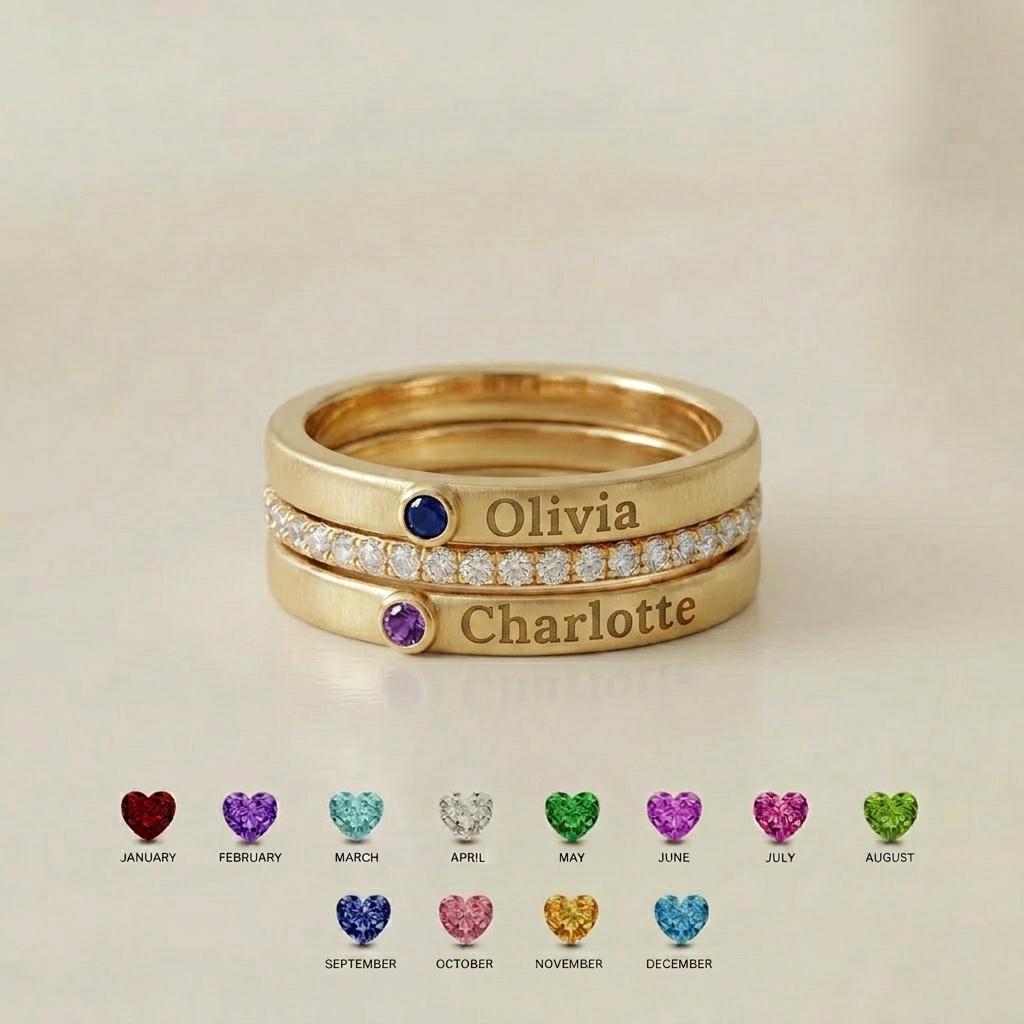
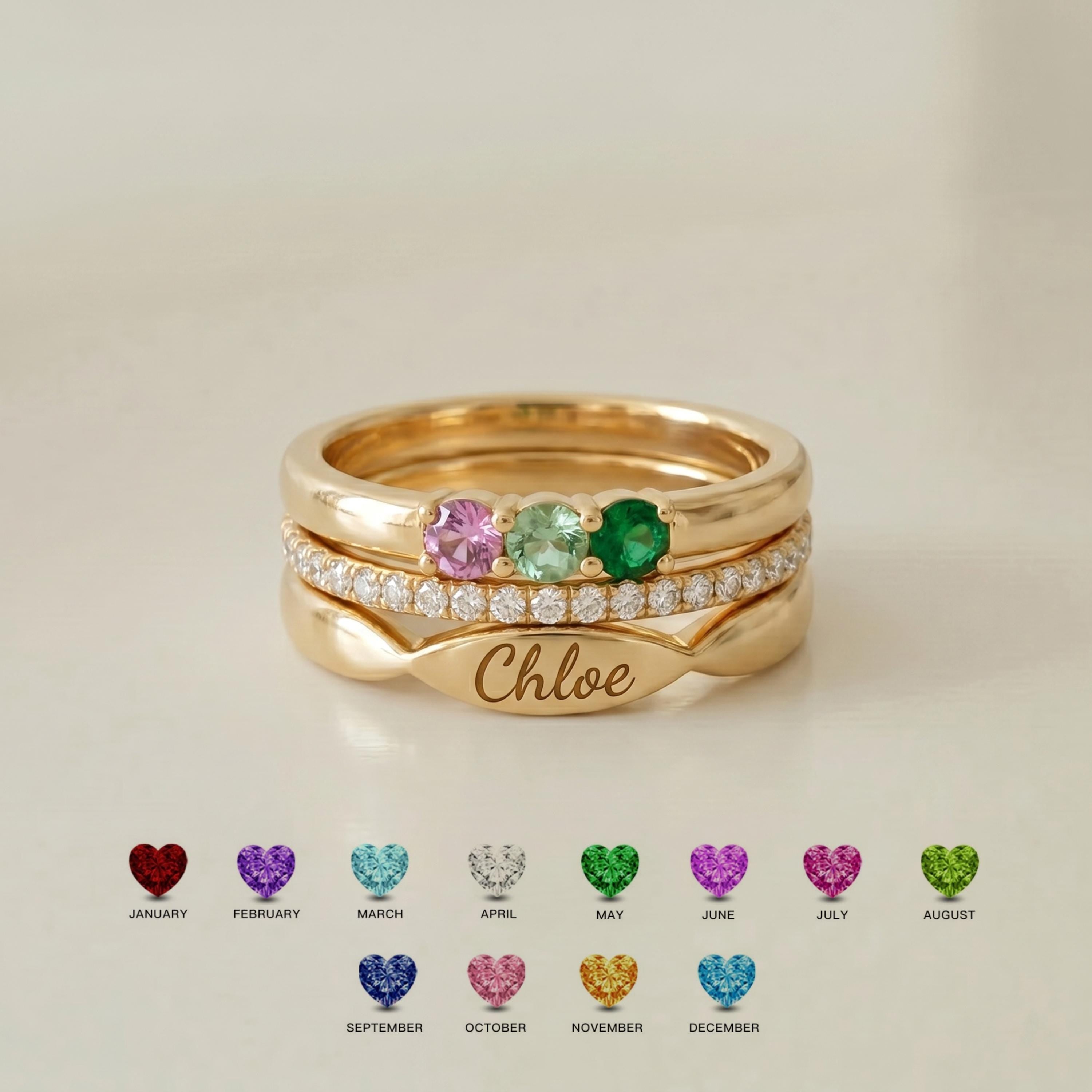
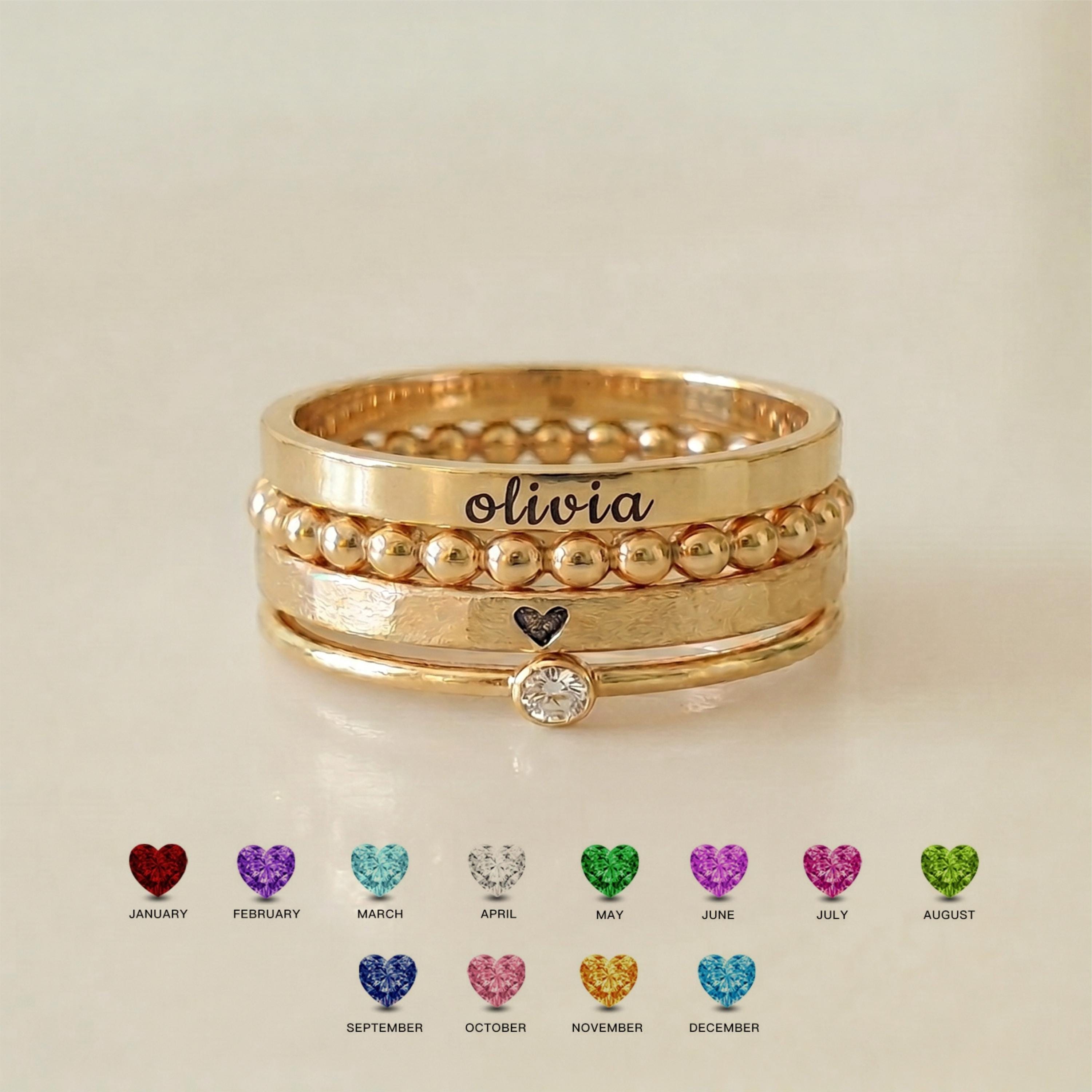
When One Ring per Child Is Useful
Choose It for Clarity, Not Because You Think You Must
Each name deserves its own space
Separate bands can keep long or visually distinct names from competing on one surface.
You like layered jewelry
The architecture works best when the wearer actually enjoys the look and feel of a stack.
You want flexible styling
Use only sets whose current description explicitly says the bands can be worn separately if that flexibility matters.
When a Single Family Ring May Be Better
Some Stories Read More Naturally as One Composition
If the wearer prefers one ring, wants several birthstones visible at a glance, or does not enjoy layered bands, a multi-stone family ring can be cleaner. BRS005, for example, places 2–7 birthstones into one mixed-shape composition.
The broader One Family Ring or a Stack of Rings? guide compares those two architectures directly. This article focuses only on why the one-person-per-layer model can work.
Before You Choose a Stack
Map the Family First
1. Count the people
Know how many personalized identities need a place.
2. Pair each name and month
Keep one complete person record instead of separate lists.
3. Confirm what each band actually carries
A set may distribute names, stones, pavé, or texture differently.
4. Check wear-together / wear-separate claims
Do not assume all multi-band sets are designed to separate.
5. Choose the wearer’s normal finish
Let their existing jewelry guide the metal color.
6. Follow the product’s field order
Transfer each name and stone exactly as the Customization Guide requests.
One Family · Separate Layers
Give Each Child a Place Without Forcing Every Detail Into One Ring
A stack works when the wearer loves layered jewelry and each person’s identity benefits from its own visual space.