.fbj{–ivory:#fbf7f2;–cream:#f5eee6;–paper:#fffdf9;–ink:#2f2925;–muted:#786d65;–line:#e8ddd2;–gold:#a98559;max-width:1120px;margin:0 auto;background:var(–paper);color:var(–ink);font-family:Georgia,’Times New Roman’,serif}.fbj *{box-sizing:border-box}.fbj .hero{display:grid;grid-template-columns:1.02fr .98fr;background:var(–ivory);border:1px solid var(–line);border-radius:22px;overflow:hidden}.fbj .heroCopy{padding:72px 9%;display:flex;flex-direction:column;justify-content:center}.fbj .hero img{width:100%;height:100%;min-height:520px;object-fit:cover}.fbj .eyebrow{font:700 12px/1.3 Arial,Helvetica,sans-serif;letter-spacing:.18em;text-transform:uppercase;color:var(–gold);margin:0 0 18px}.fbj h1{font-size:clamp(38px,5vw,66px);line-height:1.03;font-weight:400;margin:0 0 24px}.fbj h2{font-size:clamp(30px,3.5vw,47px);line-height:1.08;font-weight:400;margin:0 0 20px}.fbj h3{font-size:23px;line-height:1.2;font-weight:400;margin:0 0 10px}.fbj p{font-size:18px;line-height:1.75;color:#443c37;margin:0 0 18px}.fbj .lead{font-size:21px;line-height:1.65;color:var(–muted)}.fbj .section{padding:72px 7%;border-left:1px solid var(–line);border-right:1px solid var(–line)}.fbj .quote{padding:46px 8%;text-align:center;background:var(–cream);border-left:1px solid var(–line);border-right:1px solid var(–line)}.fbj .quote p{font-size:clamp(25px,3vw,38px);font-style:italic;line-height:1.35;color:var(–ink);margin:0}.fbj .compare{display:grid;grid-template-columns:1fr 1fr;gap:22px;margin:34px 0}.fbj .choice{border:1px solid var(–line);border-radius:20px;padding:34px;background:#fff}.fbj .choice:first-child{background:var(–ivory)}.fbj .choice ul{padding-left:20px}.fbj .choice li{font:600 15px/1.65 Arial,Helvetica,sans-serif;color:#5d534c;margin-bottom:10px}.fbj .grid2{display:grid;grid-template-columns:1fr 1fr;gap:30px;align-items:center}.fbj .photoPair{display:grid;grid-template-columns:1fr 1fr;gap:10px}.fbj .photoPair img{width:100%;aspect-ratio:1/1;object-fit:cover;border-radius:16px}.fbj .cards{display:grid;grid-template-columns:repeat(3,1fr);gap:18px;margin-top:28px}.fbj .card{border:1px solid var(–line);border-radius:16px;background:#fff;padding:25px}.fbj .note{font:600 14px/1.55 Arial,Helvetica,sans-serif;color:var(–muted)}.fbj .button{display:inline-block;background:#2f2925;color:#fff!important;text-decoration:none;padding:16px 24px;border-radius:999px;font:700 13px/1 Arial,Helvetica,sans-serif;letter-spacing:.08em;text-transform:uppercase}.fbj .related{display:grid;grid-template-columns:repeat(3,1fr);gap:16px;margin-top:28px}.fbj .related a{display:block;text-decoration:none;color:inherit;border:1px solid var(–line);border-radius:14px;padding:22px;background:#fff}@media(max-width:760px){.fbj .hero,.fbj .compare,.fbj .grid2{grid-template-columns:1fr}.fbj .heroCopy,.fbj .section{padding:48px 22px}.fbj .hero img{min-height:0;aspect-ratio:1/1}.fbj .cards,.fbj .related{grid-template-columns:1fr}.fbj .photoPair{grid-template-columns:1fr 1fr}.fbj p{font-size:17px}.fbj .choice{padding:26px}}
FarahBlush Journal · Family Ring Styles
Choose between one unified composition and a layered stack by asking one question first: how do you want the family story to be organized?
“One ring can hold the whole family together. A stack can let each person keep their own layer.”
Two Different Story Structures
Neither Approach Is More Personal—They Simply Organize Meaning Differently
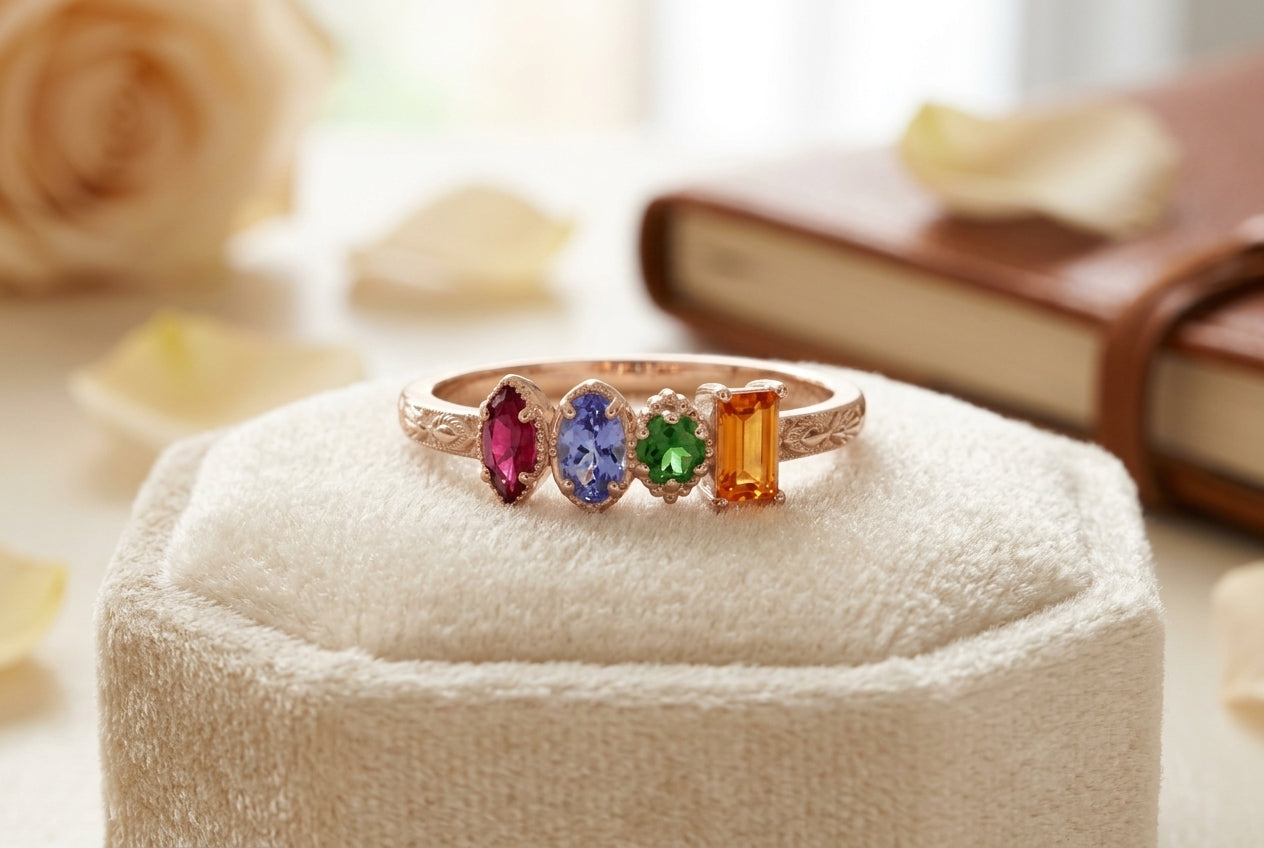
A multi-stone family ring gathers several people into one composition. A stack separates the story into layers or individual bands. Both can carry names, birthstones, or family meaning; the difference is how visibly the people are grouped.
One Family Ring
One composition, one shared story
- Several family members can be represented in one ring.
- Stone order becomes part of the personalization.
- The design reads as a single keepsake.
- Useful when you want the family visually gathered together.
Ring Stack
Several layers, one collected story
- Different bands can carry different names or stones.
- Each person can be visually separated into a layer.
- Bands can often be worn together or separately when the specific product is designed that way.
- Useful when names and individual layers are important to the story.
Choose One Ring When…
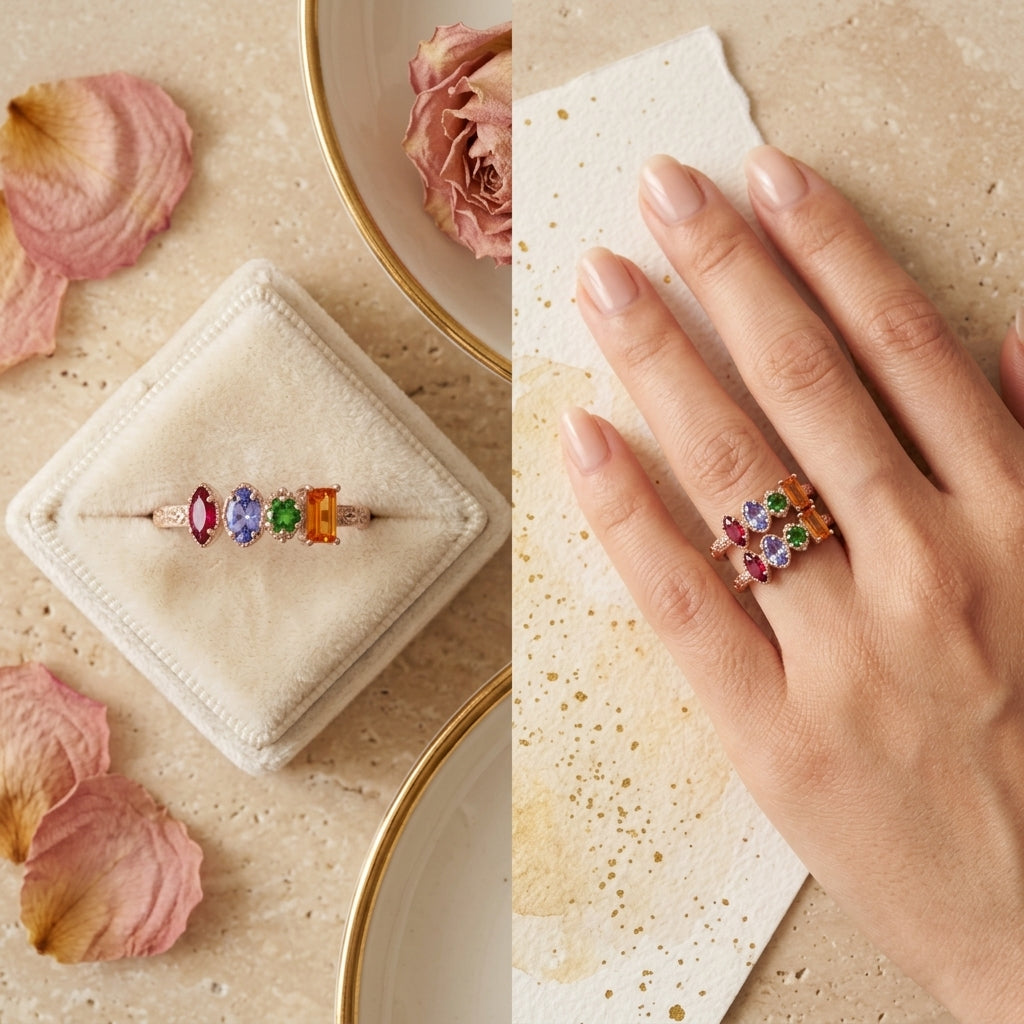
You Want to See the Family as One Composition
A multi-stone design works naturally when the emotional idea is “all of us, together.” The stones may differ in color or shape, but they belong to the same architecture.
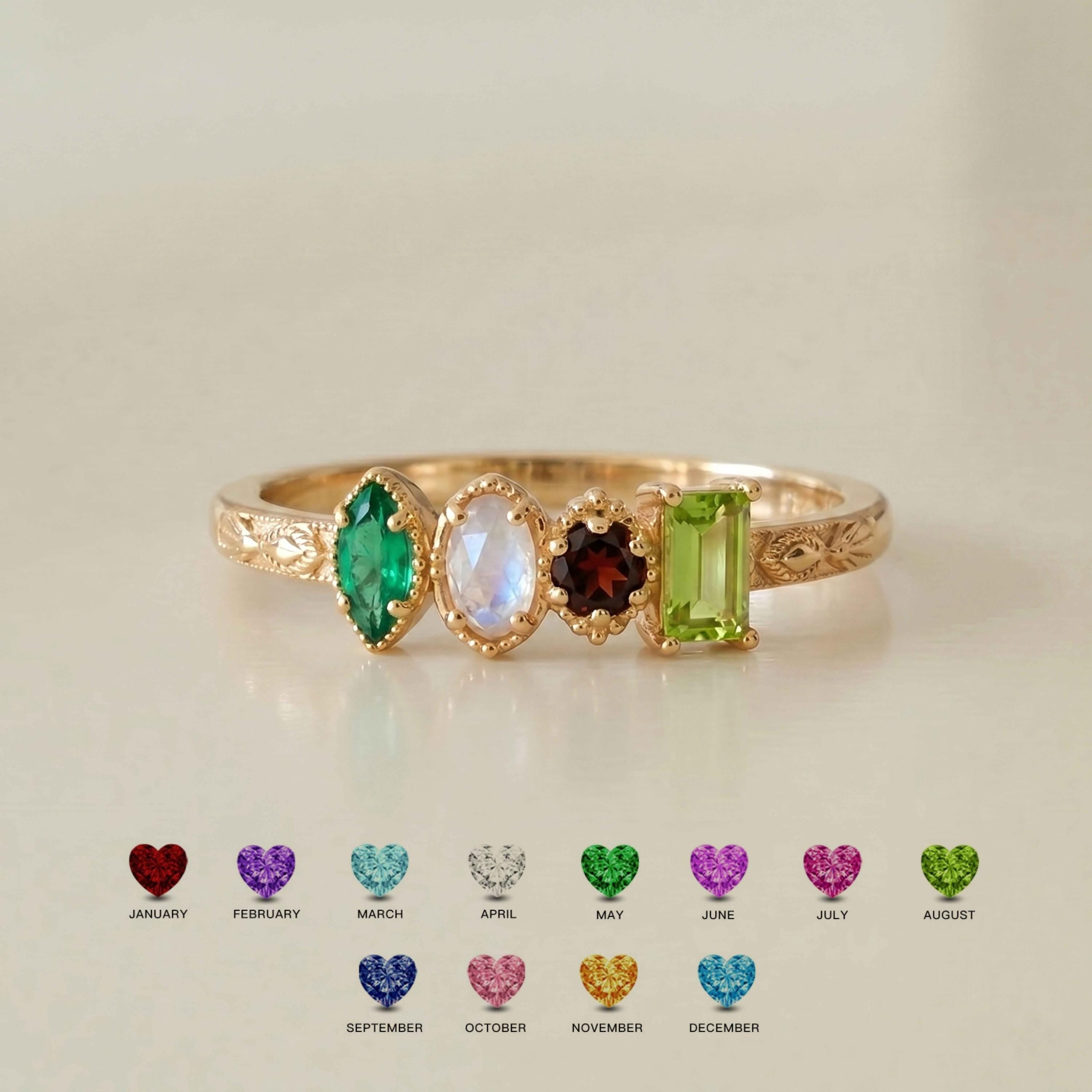
BRS005 brings 2–7 birthstones into a mixed-shape composition. BRS059 offers a 1–5 stone family layout. In both cases, the central planning task is deciding who belongs to each stone position.
If you are choosing this route, start with the family birthstone arrangement guide.
Choose a Stack When…
You Want the Story to Have Separate Layers
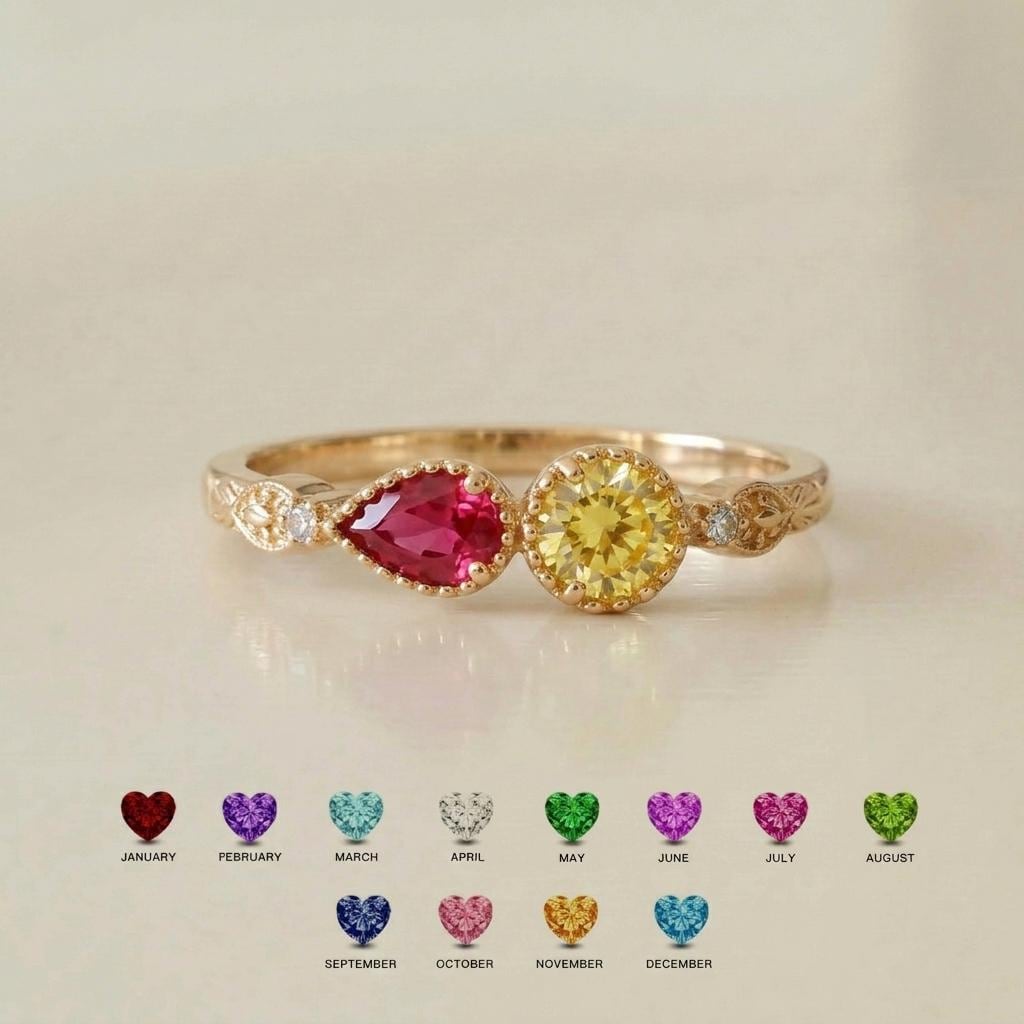
Stacks are especially useful when names need room to breathe or when you like the idea that each band can carry one part of the family story.
If you already know you want separate bands, browse Personalized Stacking Rings before comparing individual designs.
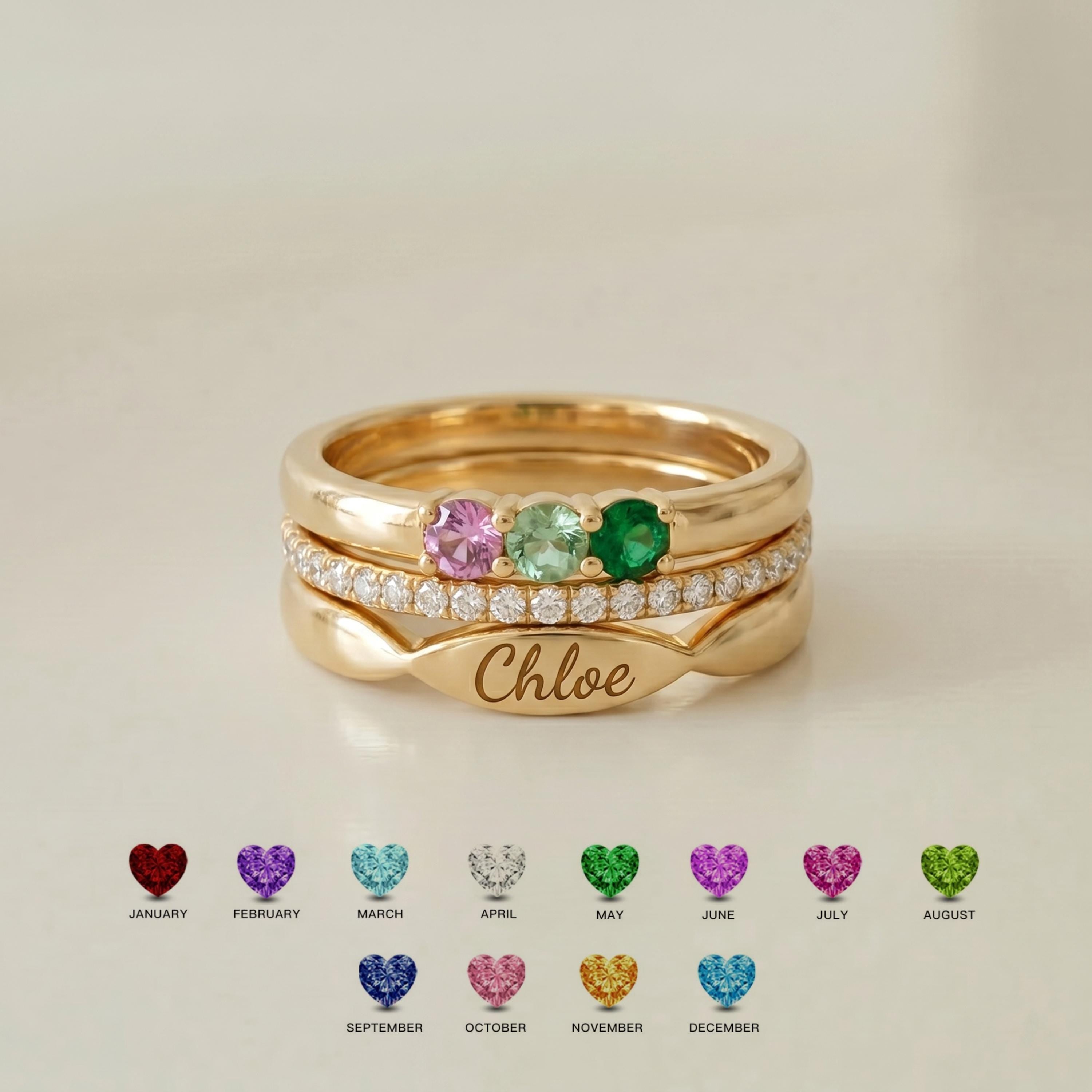
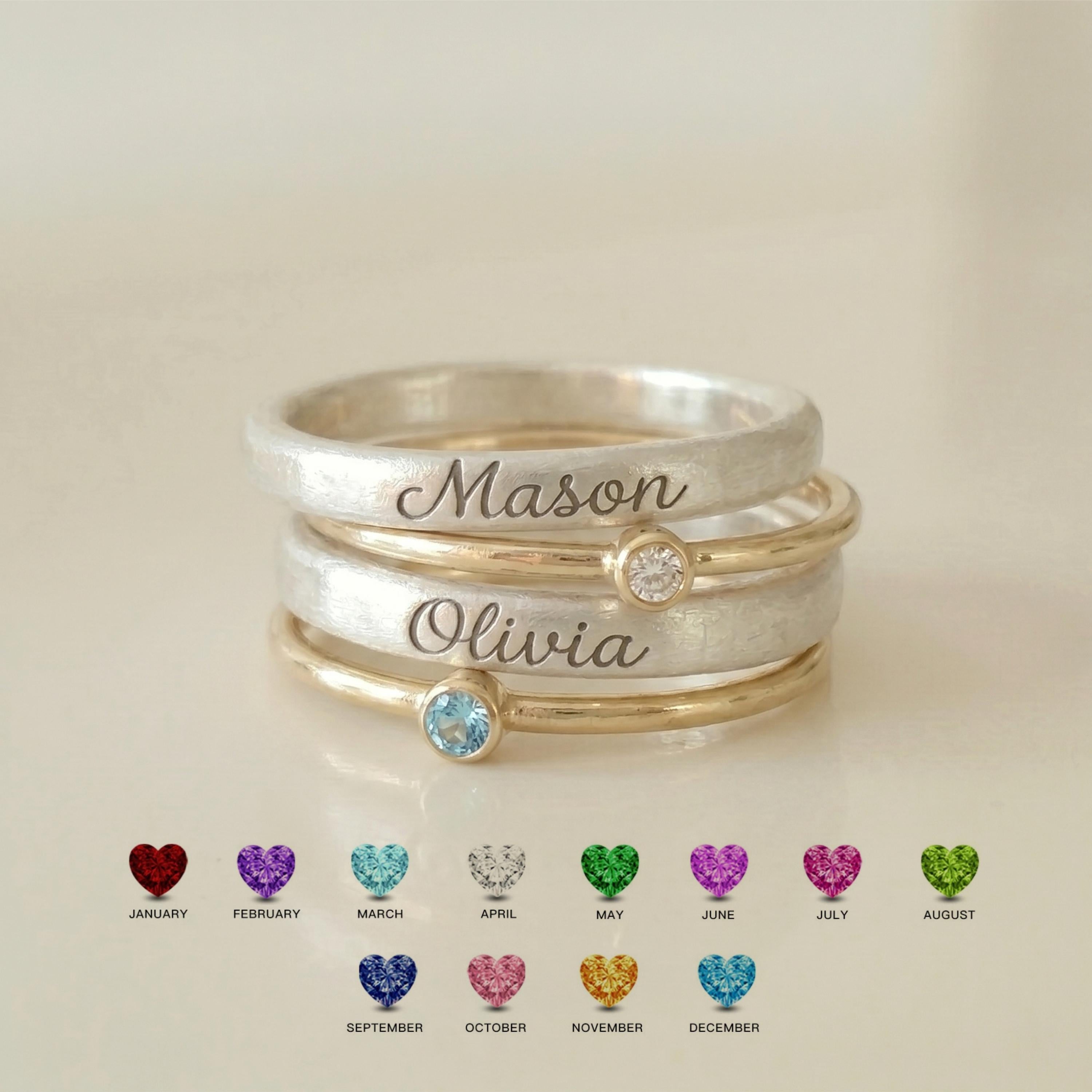
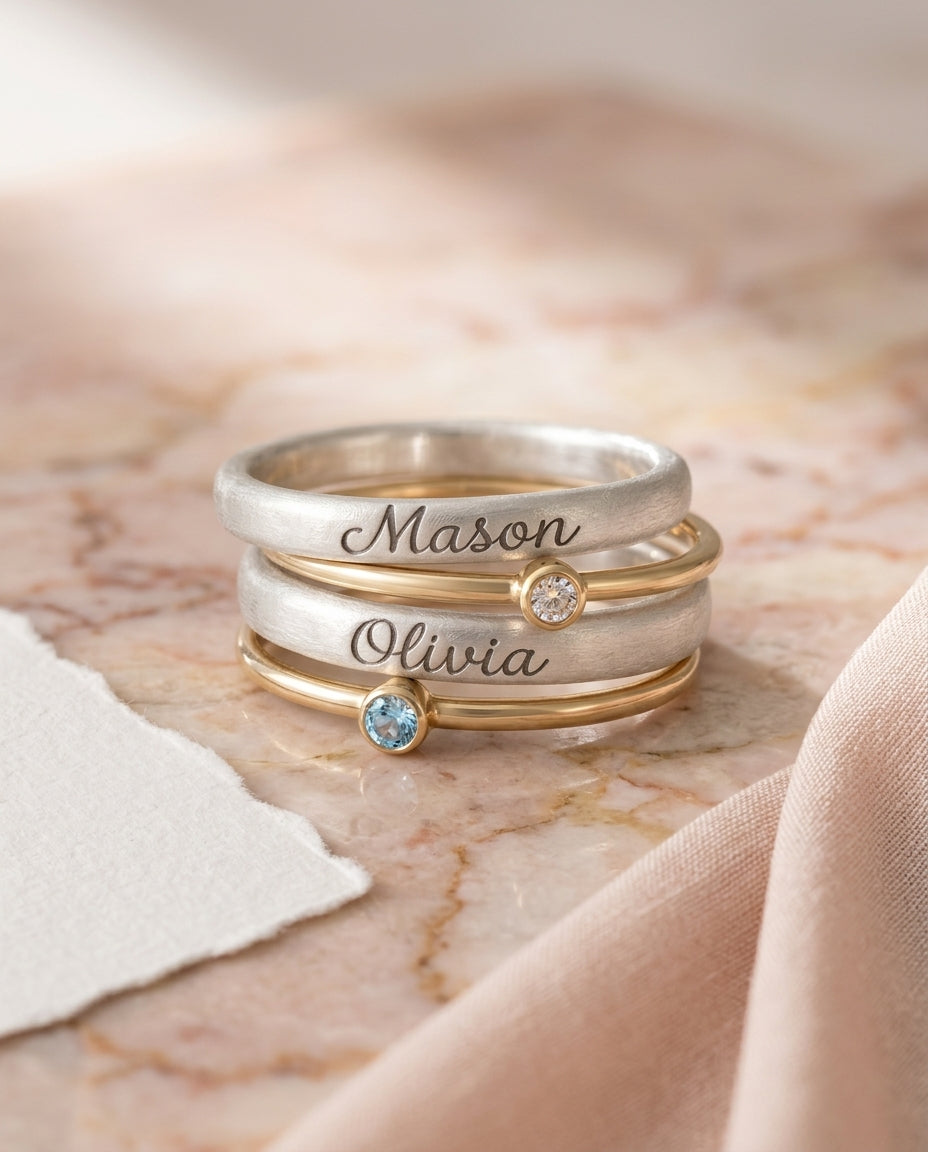
BRS003 is a three-piece stacked set that combines an engraved name plate band, a birthstone row, and a pavé band; its product description notes that the pieces can be worn together or separately. BRS011 uses custom engraved names across a stackable family-ring design.
A Simple Decision Tool
Which Story Are You Trying to Tell?
“All of us together.”
Start with a multi-stone family ring.
“One clear layer for each person.”
Explore a stack with names or one-stone-per-band structure.
“I want both names and several stones in one ring.”
Look at engraved multi-stone designs before assuming you need a stack.
“I want the simplest personalization process.”
A single ring may mean fewer separate bands and fewer design decisions.
“I like changing how I wear the set.”
Choose only products whose descriptions explicitly support wearing bands together or separately.
“Our family may grow.”
A layered system can make individual people visually distinct. If you plan to add pieces later, always check current product availability at that time.
Stacking Options in the Current Collection
Different Stacks Solve Different Personalization Problems
Before You Decide
Five Questions to Ask
1. How many people?
Count the family members the jewelry needs to represent now.
2. Do names matter?
If yes, check how much engraving space the specific product provides.
3. One composition or layers?
Choose the story structure before comparing decorative details.
4. Together or separately?
If separate wear matters, confirm that the chosen ring set supports it.
5. What does she already wear?
A person who loves layered jewelry may enjoy a stack; someone who prefers one focal ring may prefer a unified family design.
Continue the Stack Path
Choose Why You Want Separate Bands—or How to Build Them
Carry the People You Love
Choose the Structure That Makes the Family Easy to Read
One ring or several bands can both be meaningful. Start with how you want the people to relate visually, then choose the FarahBlush design that supports that story.