.fbj{–ivory:#fbf7f2;–cream:#f5eee6;–paper:#fffdf9;–ink:#2f2925;–muted:#786d65;–line:#e8ddd2;–gold:#a98559;–green:#879d7d;max-width:1120px;margin:0 auto;background:var(–paper);color:var(–ink);font-family:Georgia,’Times New Roman’,serif}.fbj *{box-sizing:border-box}.fbj .sans{font-family:Arial,Helvetica,sans-serif}.fbj .hero{display:grid;grid-template-columns:1.03fr .97fr;background:var(–ivory);border:1px solid var(–line);border-radius:22px;overflow:hidden}.fbj .heroCopy{padding:70px 9%;display:flex;flex-direction:column;justify-content:center}.fbj .hero img{width:100%;height:100%;object-fit:cover;display:block;min-height:510px}.fbj .eyebrow{font:700 12px/1.3 Arial,Helvetica,sans-serif;letter-spacing:.18em;text-transform:uppercase;color:var(–gold);margin:0 0 18px}.fbj h1{font-size:clamp(38px,5vw,66px);line-height:1.03;font-weight:400;margin:0 0 24px}.fbj h2{font-size:clamp(30px,3.5vw,46px);line-height:1.08;font-weight:400;margin:0 0 20px}.fbj h3{font-size:23px;line-height:1.2;font-weight:400;margin:0 0 10px}.fbj p{font-size:18px;line-height:1.75;margin:0 0 18px;color:#443c37}.fbj .lead{font-size:21px;line-height:1.65;color:var(–muted)}.fbj .section{padding:70px 7%;border-left:1px solid var(–line);border-right:1px solid var(–line)}.fbj .quote{padding:46px 8%;text-align:center;background:var(–cream);border-left:1px solid var(–line);border-right:1px solid var(–line)}.fbj .quote p{font-size:clamp(25px,3vw,38px);font-style:italic;line-height:1.35;margin:0;color:var(–ink)}.fbj .visual{background:linear-gradient(135deg,#fbf7f2,#f4ece7);border:1px solid var(–line);border-radius:20px;padding:46px;margin:34px 0}.fbj .people{display:grid;grid-template-columns:1fr auto 1fr;gap:28px;align-items:center}.fbj .person{background:#fff;border:1px solid var(–line);border-radius:16px;padding:28px;text-align:center}.fbj .gem{width:76px;height:76px;border-radius:50%;background:var(–green);margin:0 auto 18px;border:5px solid rgba(255,255,255,.6);box-shadow:0 0 0 1px #d6cabc}.fbj .plus{font-size:34px;color:var(–gold)}.fbj .cards{display:grid;grid-template-columns:repeat(3,1fr);gap:18px;margin-top:28px}.fbj .card{background:#fff;border:1px solid var(–line);border-radius:16px;padding:25px}.fbj .num{font:700 12px/1 Arial,Helvetica,sans-serif;color:var(–gold);letter-spacing:.14em}.fbj .grid2{display:grid;grid-template-columns:1fr 1fr;gap:32px;align-items:center}.fbj .photo img{width:100%;aspect-ratio:1/1;object-fit:cover;border-radius:18px}.fbj .button{display:inline-block;background:#2f2925;color:#fff!important;text-decoration:none;padding:16px 24px;border-radius:999px;font:700 13px/1 Arial,Helvetica,sans-serif;letter-spacing:.08em;text-transform:uppercase}.fbj .related{display:grid;grid-template-columns:repeat(3,1fr);gap:16px;margin-top:28px}.fbj .related a{display:block;text-decoration:none;color:inherit;border:1px solid var(–line);border-radius:14px;padding:22px;background:#fff}.fbj .note{font:600 14px/1.55 Arial,Helvetica,sans-serif;color:var(–muted)}@media(max-width:760px){.fbj .hero,.fbj .grid2,.fbj .people{grid-template-columns:1fr}.fbj .heroCopy,.fbj .section{padding:48px 22px}.fbj .hero img{min-height:0;aspect-ratio:1/1}.fbj .plus{text-align:center;transform:rotate(90deg)}.fbj .cards,.fbj .related{grid-template-columns:1fr}.fbj .visual{padding:24px}.fbj p{font-size:17px}}
FarahBlush Journal · Shared Birth Months
Use the same color twice. The stone represents a person in a position—not a rule that every family member must look different.
“Same month. Same color. Two completely separate places in the family story.”
The Simple Answer
Yes—Birthstone Colors Can Repeat
Families do not arrive in twelve perfectly separated months. Siblings can share a birthday month. A mother and daughter can both be born in May. Twins can share the same month and year. A larger family might even have three people represented by the same birthstone color.
None of that makes the personalization incomplete. If two people share the same month, repeating the corresponding stone color is usually the clearest way to keep the symbolism honest.
The part that distinguishes one person from another is the position, name, or written personalization map attached to that stone.
Same Month · Different People
Ava
May · Position 1
Leo
May · Position 4
Same color. Two positions. Two stories.
Why Position Matters
A Birthstone Is Symbolic; the Mapping Makes It Personal
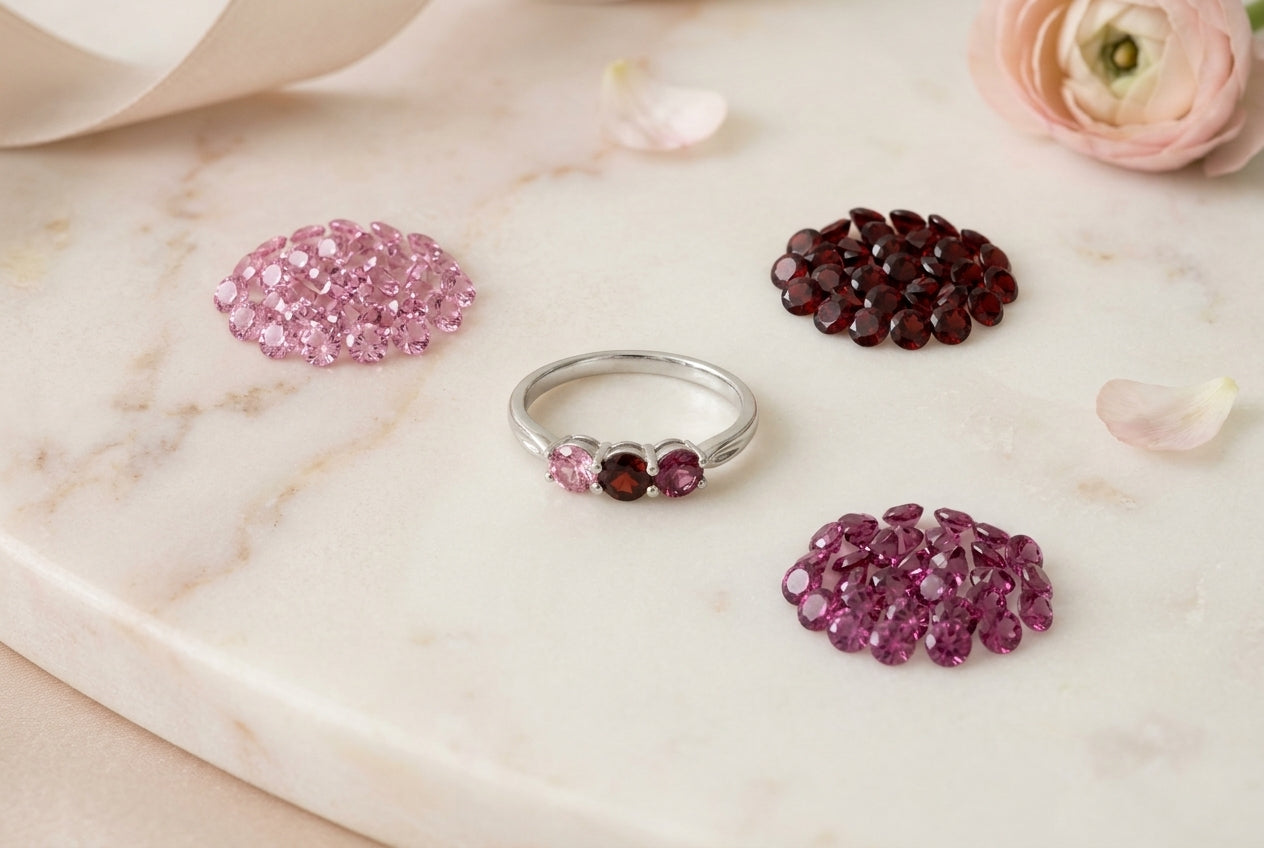
Imagine a four-stone ring where the first and fourth stones are the same color. To someone else they might simply look coordinated. To the wearer, Position 1 can mean Ava and Position 4 can mean Leo because that mapping was decided before the ring was ordered.
This is why the personalization sequence matters so much. If a product asks you to enter Stone 1, Stone 2, Stone 3, and Stone 4, treat those numbers as part of the family record. Keep the names beside them while you order, even when the final ring does not display the names.
If the product includes engraving, the relationship can be even more explicit: a name and a matching birthstone can function as a pair.
Four Common Situations
When Repeated Birthstones Make Perfect Sense
Two children, one month
Repeat the month color in two separate positions and preserve the chosen order.
Two people can share every calendar detail
Names or clearly documented positions help distinguish the individual meaning.
Shared month, different relationship
The same stone color can represent two generations without changing either person’s month.
Three or more matching months
A written position map becomes especially valuable as the number of stones grows.
Make the Mapping Visible
Names + Birthstones Can Remove Ambiguity
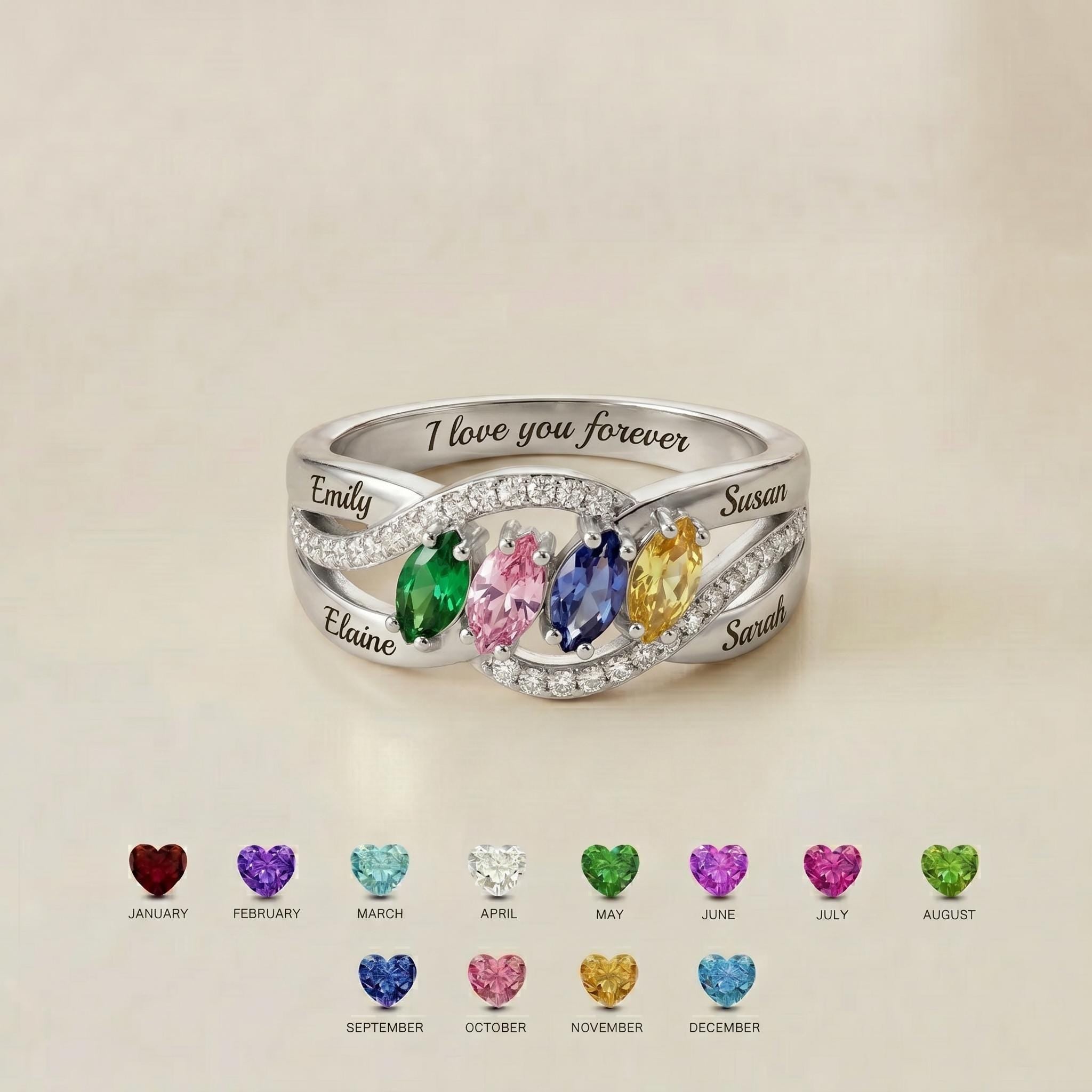
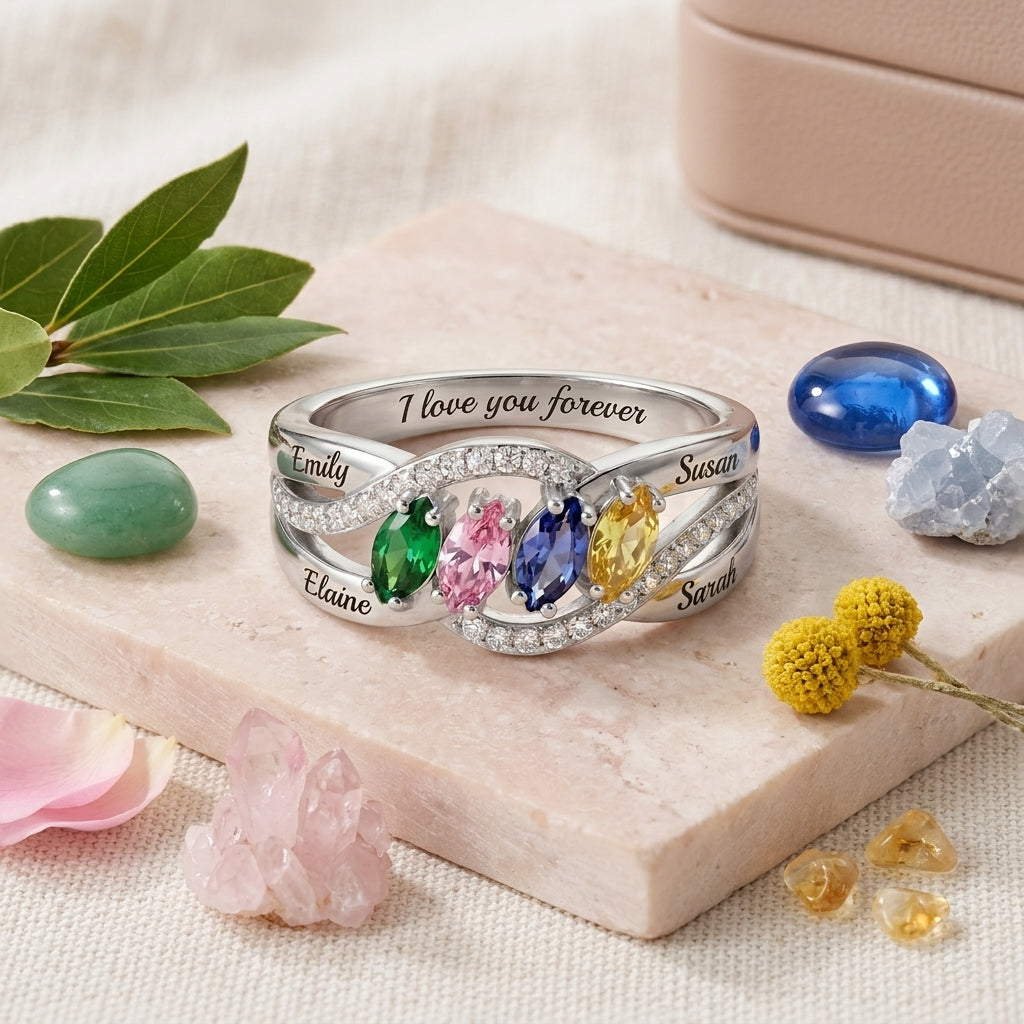
BRS061 combines four names with four birthstones, which makes it well suited to a family story where repeated months need an explicit identity beside them.
BRS024 also pairs engraved family information with matching birthstones. Its product instructions specifically rely on entering names and birthstones in corresponding order—exactly the kind of structure that helps keep repeated colors clear.
A Better Way to Order
Write the Family Map Before You Touch the Product Options
List each person
Use the exact names or labels you want to remember.
Confirm each birth month
Matching months stay matching—do not invent a different color just for variety.
Assign positions
Person 1 → Stone 1, Person 2 → Stone 2, and so on.
Follow the product guide
Transfer the map into the exact sequence requested on the product page.
Review repeated colors
Make sure every duplicate stone still occupies the intended person’s position.
If you have not chosen an ordering system yet, read How to Arrange Birthstones in a Family Ring first.
What Not to Do
Do Not Change Someone’s Birthstone Just to Make the Palette More Varied
A family ring does not need twelve different colors to be meaningful. If the design feels visually repetitive because several people share a month, use structure rather than substitution: names, positions, shape differences where the actual product provides them, or a clear family order.
You can still think about how the colors flow. Just keep the identity of the people fixed. Our guide to mixing family birthstone colors shows how to work with the palette you actually have.
Personalized Around Your Story
Let Every Person Keep Their Own Place
Whether the colors repeat or not, a clear family map makes the ring personal. Explore designs with multiple stone positions, names, and family-focused personalization.